Understanding Bell Target Air Rifle Scoring: A Complete Guide
Bell Target shooting is one of the oldest, most precise, and most rewarding disciplines in airgun sports. Dating back over a century to traditional pub leagues across the UK, the sport relies on absolute precision, consistent lead mark reading, and strict rules to declare a true winner.
At UKVARL, we adhere strictly to traditional scoring principles — such as those based on the historic Wolverhampton Air Rifle League constitution — to ensure a standardised, competitive and fair platform for shooters nationwide.
Whether you are logging your first scores or fine-tuning your technique, here is everything you need to know about how Bell Target scoring works.
The anatomy of a bell target
A standard bell target consists of a 5-inch steel faceplate coated in scoring paint to record pellet impacts. (Commonly uses baby lotion and Titanium Dioxide for the 'paint') It features:
- Central 3/8"/9.5mm diameter hole: the ultimate target area, housing the bell mechanism behind the plate.
- 4 concentric scoring divisions: circular rings etched outward from the central hole, starting at 1 inch in diameter.
The impact pattern: the "pip" and "ring"
When a dome headed match pellet (4.5mm / .177) strikes the target plate, it flattens and leaves a distinct mark in the paint:
- The dark circle: the full outer ring left by the flattened lead pellet (approximately 4.5mm across).
- The white pip: a tiny central white dot created by the centre of impact.
- Key rule: in traditional scoring, the white pip determines the score, not the outer dark lead smudge.
How the scores break down
Scores decrease as the pellet impact moves outward from the centre hole toward the outer edge of the faceplate:
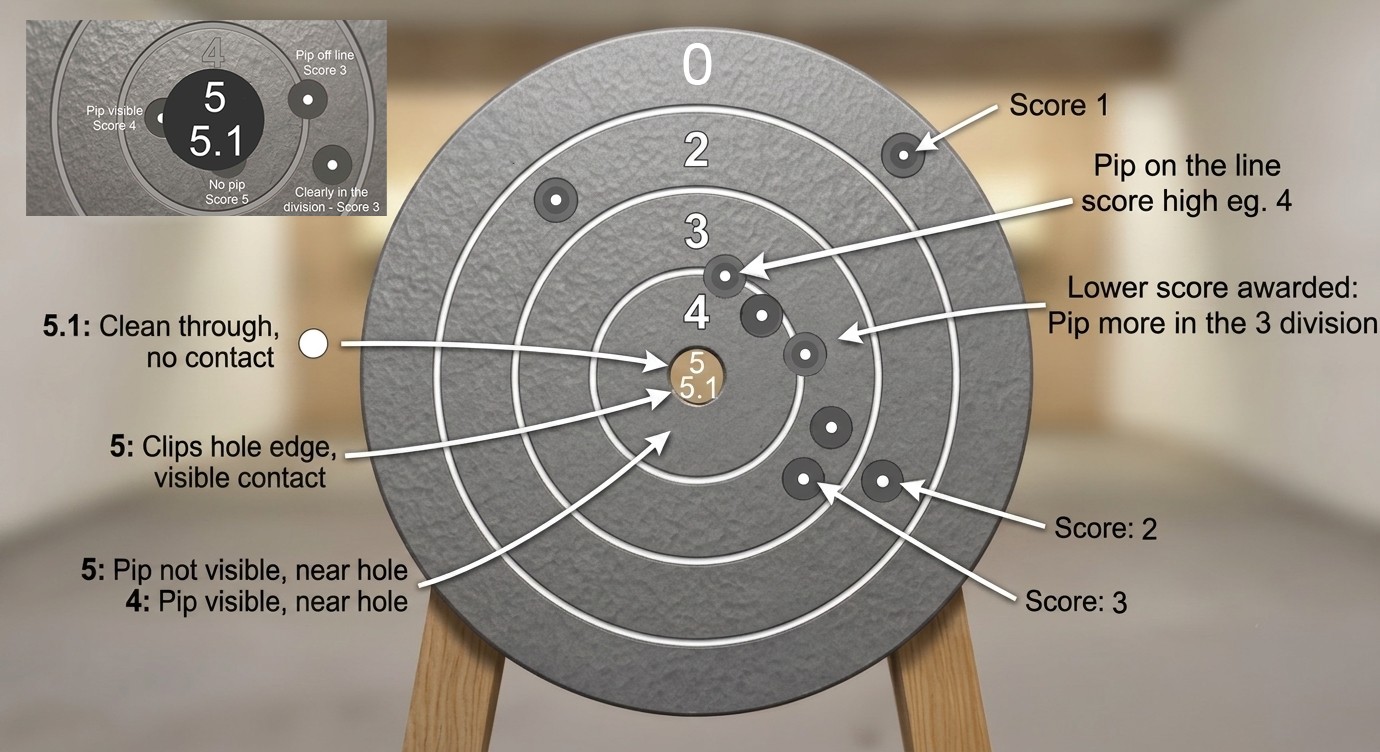
- 5.1 — clean bell hit: the pellet passes cleanly through the 9.5mm hole without touching or clipping the steel edges.
- 5.0 — clipped hole / covered edge: the pellet clips the side of the 9.5mm hole; the white pip is not visible on the outer face because it went down the hole.
- 4 — first inner division: the white pip is clearly visible on the faceplate inside the first concentric ring, or sitting directly on the line.
- 3 — second division: the white pip sits noticeably inside the 3 division ring.
- 2 — third division: the white pip sits noticeably inside the 2 division ring.
- 0 — outer division: the white pip lands on the outermost division ring.
Fine details & line decision rules
Precision sports require clear rules for edge cases. Here is how tricky impacts are scored under traditional rules.
1. The "pip on the line" rule
Unlike some modern target sports where touching a line inward gives you the lower score, bell target rewards precision:
- Higher score awarded: if the white pip lands exactly on a division line — for example right on the boundary between the 3 and 4 rings — the shooter is awarded the higher score (4).
- Lower score awarded: if the white pip is noticeably positioned further into the 3 division, it scores as a 3.
2. Edge hits near the 9.5mm centre hole
Because the 9.5mm central hole sits directly inside the 4 division, close hits near the centre require careful inspection:
- Score of 4: the pellet hits near the hole, but the central white pip is still visible on the flat faceplate.
- Score of 5: the pellet hits close enough to the hole that the white pip cannot be seen, meaning the core of the pellet struck the edge or inside of the hole.
Please NoteThe use of a probe can help to determine between a 4 or a 5 - when the probe is inserted in to the hole, if the mark can be seen past the edge of the probe it's a 4 otherwise a 5.
Why traditional scoring matters
While casual or lenient scoring systems might ignore pip placement or treat line touches loosely, traditional scoring ensures that every fraction of a millimetre counts.
By applying these exact scoring principles across the UK Virtual Air Rifle League, shooters from Scotland to Cornwall can compete on a genuinely equal playing field — bringing modern convenience to a proud, historic shooting tradition.
See also about UKVARL, FAQs and the constitution.